
On natural perfumery, the beauty of simplicity and why I believe true luxury begins long before a fragrance reaches its bottle.
What makes something truly luxurious?
Is it the weight of the box?
The layers of beautiful wrapping? The elaborate details, polished surfaces and carefully orchestrated moment of opening?
There is something wonderful about beautiful design. I appreciate good proportions, thoughtful materials and objects that are a pleasure to hold.
But when I began creating sense • studio • amsterdam, I found myself asking a different question.
What is it that makes something genuinely precious?
Is it what surrounds the product, or what goes into creating it?
For me, the answer became increasingly clear.
I wanted to put my attention, time and resources into the fragrance itself.
Into the quality of its aromatic materials. The complexity of its composition. The patience required to develop it. And the experience it creates when someone finally wears it or brings it into their home.
The packaging matters, of course.
But I believe its role is to protect and complement what is inside.
Not to compete with it.
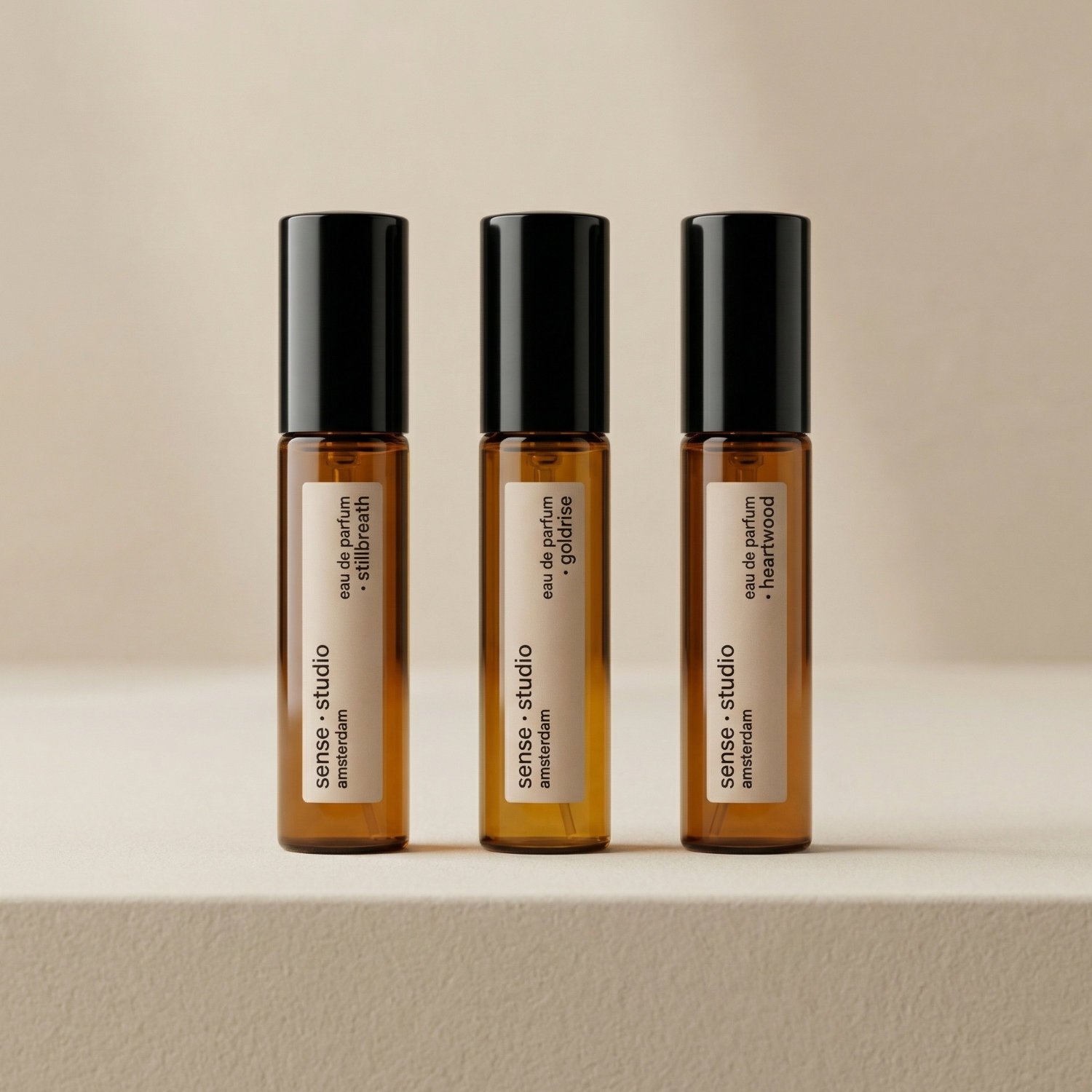
The most valuable part is often invisible
When you look at a finished perfume bottle, you cannot immediately see the work behind the fragrance.
You don't see the botanical extracts, precious woods and aromatic resins that have been carefully selected.
You don't see the dozens of materials that may be needed to create a single composition.
Or the many adjustments required to find the right balance between freshness, warmth, softness and depth.
Sometimes the most important ingredient is present in such a tiny quantity that you might never recognise it individually.
Yet without it, the entire fragrance would feel different.
This is one of the things I find most beautiful about perfumery.
So much of its complexity is invisible.
At sense • studio, I develop my own compositions using nature-derived aromatic materials: essential oils, absolutes, botanical extracts, woods, resins and naturally derived isolates.
Some of these materials are particularly precious.
A beautiful floral absolute may require enormous quantities of flowers to produce just a small amount of aromatic extract. A fragrant wood may take years to develop its characteristic scent.
Their value reflects not only the material itself, but also the cultivation, harvesting, extraction and expertise behind it.
When I choose to work with these ingredients, I am making a conscious decision about where I want the value of my products to lie.
For me, the fragrance is the luxury. Everything else should honour it.
The craftsmanship behind a beautiful fragrance
Developing a fragrance is rarely a straightforward journey from an idea to a finished formula.
Sometimes it begins with a particular material.
Sometimes with a memory, an atmosphere or a feeling I want to capture.
Then comes the experimentation.
Weighing ingredients, blending them, evaluating the result and allowing the composition time to settle.
Returning to it a few days later.
Making another adjustment.
Discovering that something beautiful on its own doesn't necessarily work in harmony with the other materials.
And occasionally realising that the best decision is to remove an ingredient rather than add another one.
My five signature fragrances; Goldrise, Heartwood, Stillbreath, Velvetglow and Holysmoke; emerged through this process of experimentation and refinement.
Each has its own character.
And creating the fragrance is only part of the work.
Four of these compositions are being expressed through different forms: eau de parfum, perfume oil, candles and Japanese-style incense. Holy Smoke has its own place as an eau de parfum.
The same fragrance behaves differently in alcohol, oil, wax and burning incense.
Each format therefore requires its own formulation work, testing and adjustments to preserve the identity of the original composition.
It takes time.
Sometimes weeks. Sometimes months.
And quite a few experiments that never become finished products.
This is the work I choose to invest in.
Not because complexity is valuable for its own sake, but because every decision contributes to the final experience.
Packaging should protect what is precious
Of course, beautiful fragrances deserve thoughtful presentation.
But I believe that packaging should begin with a practical question.
What does this product actually need?
In perfumery, the choice of container matters.
Certain aromatic materials are sensitive to environmental conditions, including exposure to light, heat and air.
This is one reason amber glass has traditionally been appreciated in apothecary practices and the storage of aromatic materials.
Its colour can reduce the transmission of some wavelengths of light, providing a degree of protection compared with clear glass.
It is not a substitute for proper storage, but it is a good example of a material chosen for a reason beyond appearance.
Throughout sense • studio, I am drawn to simple materials and forms.
Glass. Paper. Clean lines. Thoughtful proportions.
Packaging that feels beautiful to hold without requiring excessive decoration.
I don't believe a product needs multiple layers of presentation to communicate that care has gone into making it.
Sometimes, simplicity allows the object itself to become more interesting.
The colour of the glass.
The texture of the paper.
A carefully placed label.
A small detail that feels exactly right.
I think there is elegance in giving every element a purpose.
The beauty of knowing when to stop
Perhaps my approach to packaging is also connected to the world I come from.
Having spent much of my professional life in corporate environments, I know how easily everything can become focused on more.
More performance. More communication. More visibility. More impact.
And while I appreciate ambition, creativity and innovation, I have also become increasingly aware of the amount of stimulation that surrounds us.
When I started sense • studio, I wanted to explore another way of creating.
Something thoughtful, expressive and beautiful, without needing to demand attention.
This philosophy influences my fragrances, but also the objects that carry them.
I don't want a product to feel visually overwhelming before someone has even experienced what it contains.
I want the presentation to feel calm and considered.
Something that leaves room for the senses.
There is a particular confidence in knowing when an object is complete.
When another decorative element would add nothing.
When a beautiful material can speak for itself.
When simplicity is not an absence of design, but the result of careful design.
Perhaps quiet luxury is not about how much we add, but how thoughtfully we choose.
Time is part of what goes into every object
Another thing that isn't visible in the finished packaging is time.
My natural perfume candles are given approximately fourteen days to cure before their final evaluation.
Japanese-style incense sticks are shaped by hand and left to dry for around a week, depending on the conditions.
Perfumes may rest for several weeks before I complete their assessment.
These periods are part of my process, alongside the testing and refinement that each product requires.
And because I work in small batches, there are natural limits to how quickly new products can be prepared.
Occasionally, something may be temporarily unavailable while the next batch is being made.
I don't consider that a strategy for creating artificial scarcity.
It is simply the reality of working with materials, hands and time.
I want the finished product to reflect the attention that has gone into creating it.
And I would rather respect that process than rush something simply to make it available sooner.
Choosing fewer things, but choosing them well
I don't believe that a thoughtful relationship with the objects we own means giving up beautiful things.
Quite the opposite.
I think it can invite us to appreciate them more.
A favourite perfume that becomes part of our identity.
A beautifully made ceramic object that we continue to enjoy for years.
A fragrance that reminds us of a particular place or person.
A candle that accompanies a quiet evening at home.
These are not extraordinary necessities.
They are pleasures.
But there is something meaningful about knowing how they were made and why certain decisions were taken.
Knowing that the fragrance was composed rather than simply selected from a catalogue.
That natural aromatic materials were chosen for their character.
That the formula was developed with attention.
That the packaging was designed to support the object rather than distract from it.
For me, this is a more satisfying relationship with luxury.
One based on appreciation rather than excess.
Less decoration. More substance.
When I think about what I want sense • studio to become, I don't imagine increasingly elaborate boxes or more impressive packaging.
I imagine beautiful fragrances.
More knowledge. More experimentation. More confidence in the compositions I create.
I imagine working with fascinating botanical materials, refining my craft and continuing to discover new ways for fragrance to become part of everyday life.
On our skin. In our homes. In the spaces we inhabit.
I want each object to carry something of the attention with which it was made.
And I want its presentation to express that intention simply.
Because the most valuable part of a perfume may be invisible.
The skill behind its composition.
The natural materials and their extraordinary complexity.
The experiments, the patience, the decisions and the human hands involved.
And finally, the personal experience it becomes part of.
True luxury doesn't always need more decoration. Sometimes, it needs more substance.
That is why, at sense • studio • amsterdam, I choose to put more into what's inside.
And allow everything else to remain beautifully simple.
Frequently Asked Questions
Why does sense • studio choose minimalist packaging?
At sense • studio • amsterdam, I prefer to invest in the quality of the fragrance, natural aromatic materials and craftsmanship rather than elaborate packaging. The containers and materials are chosen to protect and complement the products, with an appreciation for simplicity, function and thoughtful design.
Does amber glass help protect natural perfume?
Amber glass can reduce exposure to certain wavelengths of light, helping protect light-sensitive aromatic ingredients compared with clear glass. However, proper storage remains important. Perfumes and aromatic materials should generally be kept away from excessive heat, direct sunlight and unnecessary exposure to air.
Does simple packaging mean lower quality?
Not at all. Packaging complexity and product quality are separate considerations. A fragrance may contain carefully selected botanical extracts, precious aromatic materials and months of formulation work, even when presented in a simple bottle or container. For sense • studio, the emphasis is on the quality of the composition and the care behind the finished product.
Discover the values behind sense • studio • amsterdam — an independent fragrance house exploring natural perfumery, craftsmanship and the beauty of everyday sensory experiences.